

Tshering Yangzom, 26
📍 Thimphu, Bhutan
✓ Verified
Connect with genuine, happiness-centered Bhutanese women from Thimphu, Paro, and Punakha who seek meaningful, committed relationships rooted in Buddhist mindfulness and deep family devotion. Verified profiles, video chat, and culturally respectful matchmaking.
Start Your Journey
📍 Thimphu, Bhutan
✓ Verified
📍 Paro, Bhutan
✓ Verified
📍 Punakha, Bhutan
✓ Verified
📍 Thimphu, Bhutan
✓ Verified
📍 Bumthang, Bhutan
✓ Verified
📍 Paro, Bhutan
✓ Verified
📍 Thimphu, Bhutan
✓ Verified
📍 Punakha, Bhutan
✓ VerifiedBhutanese women dating introduces Western men to partners shaped by the world's only nation that measures success not by GDP but by Gross National Happiness. Bhutan, a small Himalayan kingdom of roughly 780,000 people tucked between India and Tibet, has cultivated a society where contentment, spiritual well-being, and environmental harmony are woven into everyday life. Women raised in this extraordinary culture bring a depth of inner peace, emotional maturity, and genuine warmth to relationships that men rarely encounter anywhere else on earth.
Unlike many nations where modernization has eroded traditional values, Bhutan has intentionally preserved its Buddhist heritage while carefully integrating modernity. Television and the internet arrived in Bhutan only in 1999, making it one of the last countries to go online. This deliberate approach means Bhutanese women grew up in households where mindfulness, respect for nature, and spiritual practice were not abstract concepts but daily realities. The result is a partner who naturally prioritizes emotional well-being, honest communication, and the health of relationships over material acquisition.
Bhutan's Gross National Happiness (GNH) philosophy, introduced by the Fourth King Jigme Singye Wangchuck in 1972, rests on four pillars: sustainable development, cultural preservation, environmental conservation, and good governance. For Bhutanese women, this philosophy is not political - it is personal. They approach romantic partnerships with the same intentionality: seeking emotional sustainability, preserving cultural identity within cross-cultural unions, nurturing the relationship environment, and making fair, compassionate decisions together.
This mindset produces partners who are naturally conflict-resolvers. Bhutanese women do not escalate disagreements into battles for dominance. Instead, they draw on Buddhist teachings about impermanence and compassion to navigate challenges with patience and perspective. Western men who have experienced volatile or competitive dating dynamics in their home countries often describe dating a Bhutanese woman as a revelation - a partnership defined by calm, mutual growth rather than emotional turbulence.
Bhutan stands apart from much of Asia in its approach to gender and family. In many Bhutanese communities, particularly in western and central Bhutan, matrilineal inheritance traditions mean that property and family homes pass through the female line. Women often hold significant authority within households, managing family finances, agricultural decisions, and social obligations. This cultural history produces women who are self-assured, capable, and accustomed to being respected as equal partners - not subordinate ones.
This tradition of female empowerment distinguishes Bhutanese women from the more patriarchal structures found in some neighboring cultures. If you appreciate the strength and confidence of Bhutanese women but are also curious about the region's diverse approaches to gender, you may find it fascinating to explore connections with Nepali women, who share the Himalayan heritage but bring a distinct blend of Hindu-Buddhist cultural values and their own resilient mountain character.
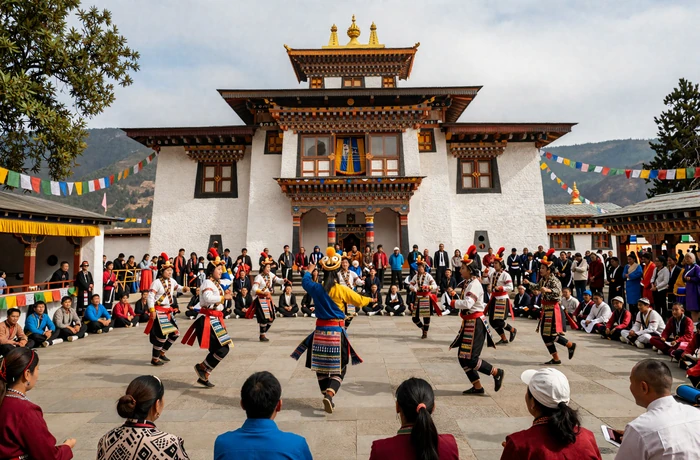
Vajrayana Buddhism permeates every aspect of Bhutanese life - from the colorful prayer flags streaming across mountain valleys to the daily rituals of butter lamp offerings and mantra recitation. Bhutanese women typically maintain active spiritual practices, visiting temples, observing tshechu (festival) dances, and consulting astrologers for auspicious dates. This spiritual grounding gives them a philosophical framework for relationships: they believe in karma, in the interconnectedness of all beings, and in treating partners with the compassion they wish to receive.
Western men need not be Buddhist to build a beautiful relationship with a Bhutanese woman. However, demonstrating genuine respect for her spiritual life - attending a festival with her, sitting quietly during her morning prayers, or simply asking thoughtful questions about Buddhist philosophy - earns profound trust and admiration.
Bhutan's dating culture in 2026 is a fascinating blend of centuries-old traditions and the practical realities of a small, increasingly connected society. Unlike many Asian nations where arranged marriages dominate, Bhutan has historically allowed considerable romantic freedom. Night hunting (bomena), a traditional courtship custom where young men would visit women's homes at night, has largely faded in modern urban areas but reflects Bhutan's more relaxed attitude toward romantic initiative compared to stricter South Asian cultures.
Today, Thimphu's growing café culture, university social circles, and online connectivity have created a modern dating landscape where educated Bhutanese women are increasingly open to meeting Western men through trusted platforms. However, the pace of courtship remains distinctly Bhutanese - unhurried, intentional, and mindful. Rushing a Bhutanese woman signals a lack of the patience she considers essential in a worthy partner.
| Aspect | Traditional Bhutanese Courtship | Modern Online Dating |
|---|---|---|
| How couples meet | Community festivals (tshechu), family connections, village gatherings | Online platforms, university networks, social media, Thimphu café culture |
| Role of family | Family approval important but not strictly required; matrilineal influence | Family blessing valued, especially from the mother's side |
| Courtship pace | Gradual, community-observed, seasonal rhythms | Moderate pace with regular messaging and video calls over months |
| Physical expression | Relatively relaxed compared to other Asian cultures | Affection expressed privately; public modesty maintained |
| Marriage expectations | Often informal unions, sometimes formalized later | Clear path toward marriage with astrological consultation for timing |
| Decision authority | Woman and her maternal family hold significant influence | Woman chooses independently with family guidance and support |
| Openness to foreigners | Rare due to Bhutan's isolation until the 1960s | Growing interest, especially among educated urban women in Thimphu and Paro |
Astrology plays a unique and significant role in Bhutanese dating and marriage. Before a couple formalizes their union, families traditionally consult a tsip (astrologer) to determine compatibility based on birth signs, elements, and lunar calendars. Auspicious dates are chosen for engagements and weddings, and the astrologer's guidance carries genuine weight. Western men who show openness to - or at least respectful curiosity about - this tradition demonstrate the cultural sensitivity that Bhutanese women deeply value.
Bhutan's small population belies significant regional variation. Women in Thimphu, the capital, tend to be more cosmopolitan, educated, and comfortable with international connections. Paro women, influenced by the town's role as Bhutan's gateway for tourists, are often warm toward foreigners and culturally sophisticated. In more rural areas like Bumthang and Haa, traditional values run deeper, and the pace of courtship is even more measured. The eastern regions of Bhutan - Trashigang and Mongar - maintain strong community-based courtship traditions where family and village involvement remains central.
Understanding these regional nuances helps you approach your Bhutanese connection with the right expectations. This regional diversity within a single culture mirrors patterns you will find across the Himalayas. Women from India's northeastern states share similar Tibeto-Burman heritage and Buddhist cultural influences, while offering the diversity of India's vast cultural landscape.
Bhutanese women seek men who place family at the center of their lives. In a culture where extended family bonds define identity and support systems, demonstrating that you value close family relationships - and genuinely want to build one - signals compatibility. Ask about her parents, siblings, and family traditions to show you understand what matters most.
Inner calm, emotional awareness, and compassion are not optional extras for Bhutanese women - they are fundamental expectations of a good partner. She values a man who can pause before reacting in anger, who approaches disagreements with a desire to understand rather than win, and who practices genuine kindness in daily life.
Respect in Bhutanese culture extends beyond polite behavior - it encompasses respect for her culture, her spiritual practice, her family's customs, and her autonomy as an equal partner. Bhutanese women from matrilineal backgrounds expect mutual decision-making, not patriarchal authority. Demonstrating respect earns lifelong loyalty.
While financial stability matters to Bhutanese women - they are practical and grounded - they do not prioritize wealth the way Western dating cultures might expect. A man who earns a modest income but demonstrates emotional maturity, spiritual curiosity, and genuine commitment is far more attractive to a Bhutanese woman than a wealthy man who lacks self-awareness or compassion. This reflects the GNH philosophy at a personal level: happiness and relationship quality outweigh material accumulation.

Bhutanese women are raised surrounded by some of the most pristine natural environments on earth - ancient forests, crystal rivers, and mountain vistas that most people only see in photographs. They value partners who appreciate the outdoors, who find joy in hiking a forest trail, sitting quietly by a river, or watching the sunrise over the Himalayas. If your idea of a perfect date involves being in nature rather than at a noisy nightclub, you and a Bhutanese woman will naturally align.
This deep connection to landscape and simple living resonates with women across the Himalayan belt. Nepali women share this mountain heritage and appreciation for nature, while bringing their own unique blend of Hindu and Buddhist traditions to the relationship dynamic.
Sign up in under two minutes. Upload genuine photos, describe your interests and relationship goals, and indicate your interest in Bhutanese singles. No credit card needed to begin browsing.
Explore verified Bhutanese women from Thimphu, Paro, Punakha, and Bumthang using advanced filters for age, education, values, and location. Each profile includes verified photos and detailed personal information.
Send a thoughtful first message, then build trust through video calls. Our cultural guides help you navigate Bhutanese dating customs with confidence and sensitivity.
Building a successful relationship with a Bhutanese woman requires cultural sensitivity, genuine curiosity, and the patience to let connection develop naturally. These actionable tips are designed to help you navigate the unique aspects of Bhutanese dating culture and earn the trust of a woman whose values may be quite different from what you have experienced before.
Visiting Bhutan requires more planning than most Asian destinations, but the effort is well worth it. All visitors (except citizens of India, Bangladesh, and the Maldives) must obtain a visa through a licensed Bhutanese tour operator. The Sustainable Development Fee covers accommodation, meals, a guide, and internal transportation, making Bhutan surprisingly all-inclusive once you arrive. Paro International Airport, served by Druk Air and Bhutan Airlines, is the primary entry point. Flights typically route through Bangkok, Kathmandu, Delhi, or Singapore.
For Western men exploring the broader Himalayan region, combining a Bhutan visit with time in neighboring Nepal offers an enriching travel experience and the opportunity to understand the cultural similarities and differences across these mountain kingdoms. Our guide to Nepali women dating provides complementary insights into the Hindu-Buddhist cultural blend that characterizes the broader Himalayan dating landscape.
While Bhutan's small population means a smaller diaspora than many Asian nations, growing communities of Bhutanese women live in the United States, Australia, Canada, and Europe - particularly in cities like Columbus (Ohio), which hosts one of the largest Bhutanese-American populations. Connecting with diaspora Bhutanese women can offer the advantage of shared time zones, English fluency, and familiarity with Western culture, while still maintaining the Buddhist values, family devotion, and Gross National Happiness mindset that make Bhutanese women such exceptional partners.
The Bhutanese diaspora shares overlapping communities with the broader South Asian diaspora. If you are exploring connections with Himalayan women in the US, you may also encounter wonderful women from India's diverse cultural landscape, including women from northeastern Indian states like Sikkim and Arunachal Pradesh who share Bhutan's Tibeto-Burman heritage and Buddhist foundations.
Yes. While Bhutan is a small country with a population of about 780,000, an increasing number of educated Bhutanese women - particularly in Thimphu and Paro - are open to international relationships. The Bhutanese diaspora in the United States, Australia, and Europe also provides meaningful connection opportunities. Our platform connects you with verified Bhutanese women who are genuinely interested in cross-cultural partnerships built on mutual respect and shared values.
No. Most Bhutanese women do not require their partner to be Buddhist, but they do expect genuine respect for their spiritual practice. Showing interest in Buddhist philosophy, attending festivals with an open mind, and respecting her daily rituals like butter lamp offerings and mantra recitation go a long way. Dismissing or belittling her faith is the fastest way to lose a Bhutanese woman is trust.
Bhutan charges a Sustainable Development Fee of $100 per day (2026 rate for most nationalities) on top of accommodation, meals, and tour guide costs. A typical 7-10 day visit costs approximately $2,500-$4,000 all-inclusive, excluding international flights. Flights to Paro from Bangkok, Kathmandu, or Delhi range from $400-$800 roundtrip. While pricier than neighboring countries, the fee ensures an uncrowded, authentic experience and signals serious commitment to your Bhutanese partner.
Astrology is genuinely important in Bhutanese culture. Families traditionally consult a tsip (astrologer) to assess compatibility between partners and choose auspicious dates for engagements and weddings. While younger urban women may place less weight on astrology, most families still value this tradition. Showing openness and respectful curiosity about the process demonstrates cultural sensitivity that Bhutanese families deeply appreciate.
Family approval is very important, though Bhutan is generally more relaxed about it than many South Asian cultures. The maternal side of the family often holds particular influence due to matrilineal traditions in many Bhutanese communities. Earning her mother is respect and blessing is often the most significant milestone in a Bhutanese courtship. Showing genuine interest in her family, being respectful to elders, and bringing thoughtful gifts during visits builds the trust needed for formal approval.
Dzongkha is the national language of Bhutan, but English is widely spoken among educated Bhutanese women, as it is the medium of instruction in schools. Many women also speak Sharchopkha (eastern Bhutan) or Lhotshamkha (southern Bhutan) depending on their regional background. Communication barriers are generally minimal with educated Bhutanese women, especially those from Thimphu and Paro who have regular exposure to international visitors and media.